Most building owners don’t think about their metal roof until something goes wrong inside the building. A water stain on the ceiling. A drip near an HVAC unit. By that point, the damage has already moved well past the surface. A corroded fastener or a failing seam starts as a small, fixable problem. Without attention, it opens a path for water to work through the roof assembly, into the insulation, and down to the structural decking below. In Rochester, NY, where temperatures swing hard between seasons, and freeze-thaw cycles repeat all winter, that progression happens faster than most building owners expect.
At Empire State Commercial Roofing, we work directly with facility managers, building owners, and maintenance supervisors across central New York who are dealing with exactly these situations. As commercial roof repair contractors, we see firsthand how quickly a deferred repair turns into a much larger project. This article covers what that progression looks like, the warning signs to watch for, and what a qualified metal roofing contractor does to stop damage before it spreads.
How Deferred Metal Roof Repairs Compound Over Time
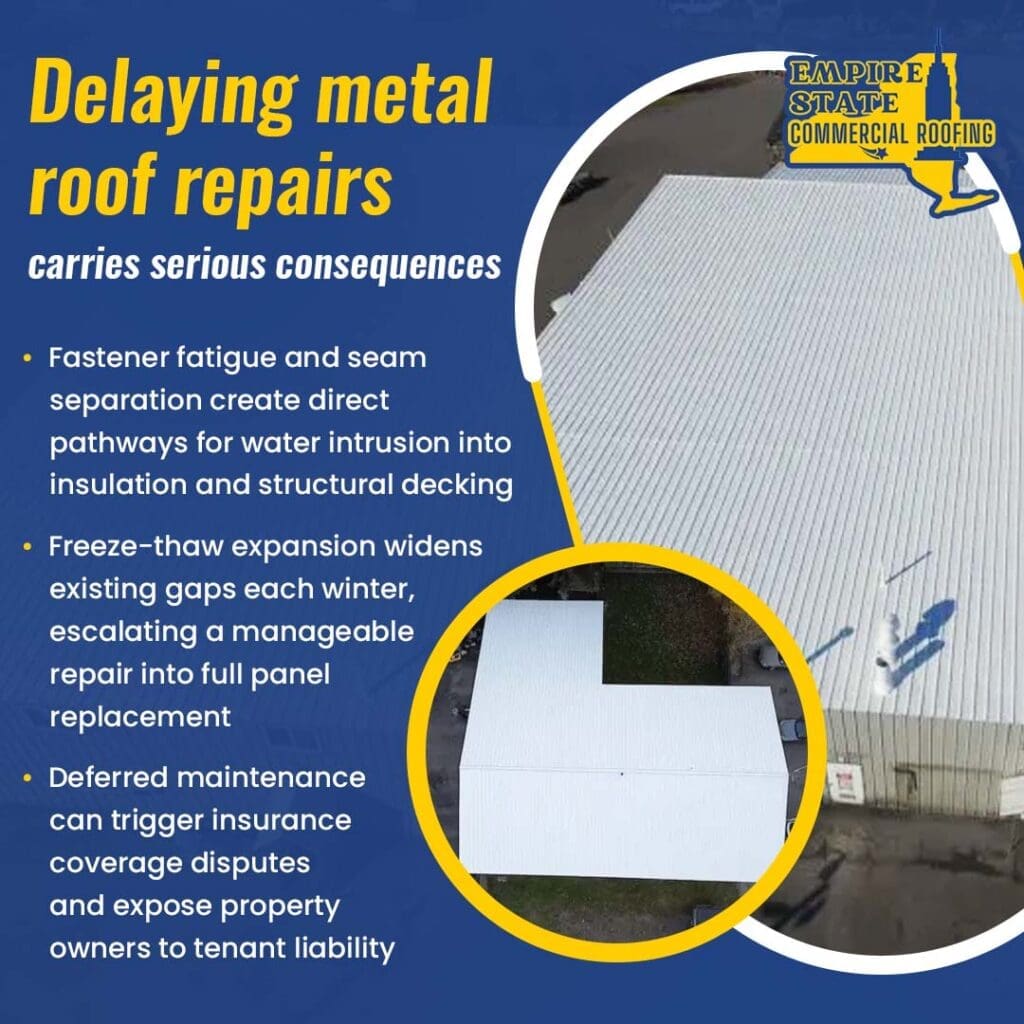
Deferred metal roof repairs follow a predictable pattern, where the isolated damage spreads to adjacent components, turning a targeted fix into a full-scale restoration or replacement project.
Metal roofing systems function as interconnected assemblies. Intact coatings protect fasteners from rust. Sound fasteners hold seams closed. Closed seams keep water off the structural roof deck. When one component fails and goes unaddressed, it transfers stress to surrounding elements that had been performing normally.
For example, an office building with loose fasteners along its ridge line experiences wind-driven rain infiltrating the insulation layer. By the time interior ceiling stains appear, the moisture has already compromised the roof deck, a structural issue that early fastener replacement would have avoided entirely.
Warning Signs That Repairs Are Needed
The following conditions signal that a commercial metal roof requires professional evaluation. Each one indicates damage that is already present, not merely a future risk.
Water Intrusion Evidence
Ceiling stains, visible drips during rainfall, or pooling near HVAC units and skylights indicate active water infiltration. By the time moisture appears inside a building, it has already passed through the roofing membrane and into the insulation or deck below.
Surface Rust and Coating Deterioration
Rust appearing on metal panels signals that protective coatings have broken down. Coatings are factory-applied or field-applied layers that block UV exposure and prevent oxidation on steel or galvanized metal substrates. Once coatings fail, rust spreads at an accelerating rate as more bare metal becomes exposed to the elements.
Loose or Missing Fasteners
Fasteners, the screws and washers that secure metal panels to the roof structure, are subject to thermal fatigue. In Rochester’s climate, where temperatures swing considerably between seasons, metal panels expand and contract repeatedly. Over time, this movement loosens fasteners or pulls them free, creating gaps for water entry and panel movement during high winds.
Ponding Water
The water that remains on the roof surface for more than 48 hours after rainfall is called ponding water. This condition indicates a drainage issue. Standing water adds structural load to the roof that was not designed to carry the load continuously and accelerates corrosion wherever it contacts metal panels.
Increased Energy Costs
Reflective roof coatings reduce solar heat gain by reflecting UV rays rather than absorbing them. When coatings deteriorate, surface temperatures rise, and cooling loads inside the building increase. A considerable rise in energy costs without a corresponding operational change can point to coating failure across the roof surface.
Reaching out to metal roofing contractors near you at the first sign of trouble gives your building the best chance of avoiding a repair scope that has grown well beyond what early intervention would have required.
Rochester’s Climate and Its Effect on Metal Roof Damage
Rochester’s freeze-thaw cycle directly accelerates metal roof deterioration when repairs are not addressed before winter arrives.
Water entering a seam or fastener gap in the fall freezes and expands during winter temperatures. That expansion physically widens existing gaps, forces panels further apart, and creates larger entry points by spring. A seam repair that was manageable in October may require panel replacement by March.
Ice dams form when meltwater backs up behind frozen eaves, creating hydrostatic pressure against flashing. Flashing refers to the metal strips that seal roof edges, penetrations, and transitions between roofing components. Damaged flashing that holds under light rain often fails under the pressure created by ice dam accumulation.
Commercial roof repair contractors in Rochester, NY, account for seasonal timing when scheduling repair work. Completing repairs before freeze-thaw cycles begin protects buildings through a full winter season and prevents the accelerated damage that occurs when known defects are left exposed to ice and snow.
Business and Operational Risks of Deferred Roof Maintenance
Beyond structural damage, deferred metal roof repairs create direct financial and legal exposure for commercial property owners.
Inventory and Equipment Loss
Warehouses, manufacturing facilities, and storage buildings face direct losses when roof leaks go unaddressed. A single rain event entering through a failed seam can damage stored goods, ruin equipment, or force unplanned production shutdowns. These losses routinely exceed what prompt repair would have required.
Insurance Coverage Complications
Commercial property insurance policies often include maintenance standards as a condition of coverage. When a claim is filed following a roof failure, insurers may investigate whether known damage was addressed within a reasonable timeframe. Pre-existing conditions that were not repaired can result in partial or full denial of coverage, leaving building owners responsible for the full scope of resulting damage.
Tenant and Lease Disputes
For commercial properties with tenants, recurring water intrusion incidents damage the landlord-tenant relationship and may provide legal grounds for lease disputes or rent abatement claims. Addressing metal roof repairs promptly protects both the property and the tenancy relationships that support its income.
Mold and Air Quality Concerns
Moisture trapped inside a roof assembly creates conditions for mold growth within insulation, ceiling materials, and structural components. Mold remediation in a commercial building is a regulated process and can require temporary displacement of building occupants or operations, adding to the overall scope of the problem.
What a Professional Metal Roof Inspection Covers
A professional inspection documents current roof conditions, identifies developing problems, and gives building owners a clear, evidence-based scope of work. Metal roofers evaluate the following during a commercial inspection:
- Fastener integrity across the entire roof surface, checking for loose screws, missing washers, and areas where fasteners have pulled through panels.
- Seam conditions at all panel overlaps, testing sealant adhesion, and identifying separation from thermal cycling or wind stress.
- Coating thickness and adhesion, assessing whether existing coatings still protect the substrate or have deteriorated past their useful service life.
- Flashing condition at all penetrations, edges, and transitions where separate roofing components meet.
- Drainage performance, confirming that water moves off the roof rather than accumulating in low-lying areas.
- Thermal imaging, which detects moisture trapped inside the roof assembly. This technology identifies hidden saturation that is invisible from the surface but actively damages insulation and decking below.
The inspection produces a written report with photographs, a documented scope of recommended repairs, and an honest assessment of whether targeted repair or broader restoration suits the building’s actual condition. This report gives building owners an objective basis for decision-making rather than relying on assumptions or visible surface conditions alone.
According to the National Roofing Contractors Association, roofs should be inspected at least twice per year, typically in spring and fall, to catch seasonal wear before it advances.
Frequently Asked Questions
Can a commercial metal roof be repaired during winter in Rochester, NY?
Winter repairs are possible but limited by temperature and moisture conditions. Most sealants, coatings, and adhesives require surface temperatures above a manufacturer-specified minimum to bond correctly. Metal roofers can address emergency leaks during winter, but planned repair work is best scheduled during fall or spring when conditions allow for proper material application and curing.
Will a repaired metal roof section match the rest of the existing roof?
Panel color and finish on an older metal roof will have weathered over time, so an exact visual match is not always achievable with new panels. Experienced metal roofers source materials that are as close a match as possible and can advise building owners on what to expect before the metal roof repair work begins.
How does a building owner document roof conditions for insurance purposes?
The most reliable approach is to schedule professional inspections at regular intervals and retain the written reports and photographs produced by the contractor. This documentation establishes a clear maintenance record that demonstrates the building was being monitored and problems were addressed promptly. Commercial roof repair contractors in Rochester, NY, typically provide this documentation as a standard part of the inspection process.
What role does roof drainage design play in metal roofing longevity?
Drainage design directly affects how long a metal roof performs. A roof with inadequate slope, blocked gutters, or undersized drains retains water longer than it should, accelerating corrosion and adding structural load. Metal roofing contractors near you can assess drainage performance during a routine inspection and recommend corrections that reduce long-term wear on the system.
Is it possible to apply a roof coating over an existing metal roof that has surface rust?
Surface rust must be treated before any coating is applied. Applying a coating directly over untreated rust traps moisture beneath the surface, which accelerates corrosion rather than stopping it. The correct process involves removing loose rust mechanically, applying a rust-inhibiting primer, and then applying the coating system in the sequence the manufacturer specifies. A qualified commercial roof repair contractor will follow this process without exception.
Why Rochester Building Owners Trust Empire State Commercial Roofing
Since 2012, Empire State Commercial Roofing has served building owners, facility supervisors, and maintenance managers across Rochester and surrounding areas, handling metal roofing projects on warehouses, factories, office buildings, and retail centers of all sizes.
Conklin Factory Certification
At Empire State Commercial Roofing, we hold factory certification with Conklin, a leading manufacturer of commercial roof coatings and roofing systems. This certification requires ongoing education and quality compliance, which means our metal roofers stay current with the latest application standards, material specifications, and system requirements. Building owners can trust that the products we apply are installed the way the manufacturer intends.
Transparent Inspection Process
Every project we take on begins with a thorough roof inspection. We document all findings with photographs and a written report before any work begins. This gives building owners a clear picture of existing conditions, what repairs are needed, and why. There are no assumptions and no surprises once work starts.
Leak-Free Warranty and Maintenance Plans
Our roof repair work is backed by a leak-free warranty. At Empire State Commercial Roofing, we also offer annual maintenance plans that keep roofs monitored between inspection cycles, catching developing problems before they advance into larger repair scopes. For building owners who want consistent protection without managing it themselves, this ongoing support makes a practical difference.
Take Action Before the Damage Spreads Across Your Rochester Property
Every season that metal roof repairs are deferred adds to the potential damage scope and reduces the available options for intervention. Targeted repairs address problems at their earliest point. Restoration, when performed before deterioration becomes severe, extends roof life by decades. Both options narrow as damage spreads.
Empire State Commercial Roofing has served commercial property owners across central New York since 2012, specializing in metal roof repair and restoration for warehouses, factories, office buildings, and retail centers. Our work is backed by leak-free warranties and annual maintenance plans designed to keep roofs performing between inspection cycles. We serve building owners, facility supervisors, and maintenance managers in Rochester and nearby areas throughout central New York.
The sooner you connect with metal roofing contractors near you, the more options remain available for your building. Call (315) 857-6988 to schedule a roof inspection with Empire State Commercial Roofing today.