Commercial flat roofs in Rochester, NY, take a direct hit from some of the most demanding weather conditions in the country. Lake-effect snowstorms, spring hailstorms, high winds, and freeze-thaw cycles put constant stress on flat and low-slope roofing systems throughout the year. When a storm causes damage, the way a building owner responds in the days that follow determines how far that damage spreads and how much structural impact it causes. Calling a qualified storm damage repair contractor within the first few days after a storm is the most direct way to keep repairs manageable.
Empire State Commercial Roofing has served commercial building owners, facility supervisors, and maintenance managers across Rochester and the surrounding communities since 2012. From routine roof inspections and storm damage repairs to full roof restoration, our team handles commercial roofing projects of all sizes for building owners and facility managers across the region. This article covers how flat roofing systems sustain storm damage in New York’s climate, what that damage looks like on common commercial roof types, and how to work through the repair process with a qualified roof repair contractor from assessment through completion.
How New York’s Weather Creates Storm Damage on Flat Roofs
Rochester, NY receives an average of 90 to 102 inches of snow per year, with approximately half of that total driven by lake-effect snow off Lake Ontario, according to the National Weather Service. That snowfall, combined with spring hail events and high-wind storms, creates a persistent and recurring risk for commercial flat roofs across the region.
Flat and low-slope roofs are more vulnerable to storm damage than pitched roofs for a straightforward reason. They have no slope to shed water, snow, or debris. Everything that lands on the surface stays there until drainage systems move it off. When drains, scuppers (roof-edge openings that allow water to exit), or gutters are blocked or overwhelmed during a storm, water accumulates and places structural stress on the roof assembly.
Freeze-thaw cycling compounds that risk. Water that enters a small crack or seam during a rain event expands when it freezes, widening the opening. Over a Rochester winter with multiple freeze-thaw cycles, what begins as a minor seam gap can develop into a significant water infiltration point by spring.
Commercial properties in Rochester, Syracuse, Henrietta, Geneva, Canandaigua, and Painted Post all face these conditions. Building owners and facility managers who understand how weather stress progresses into structural damage are better positioned to act before repairs become extensive.
Storm Damage Patterns Across the Three Main Flat Roof Systems
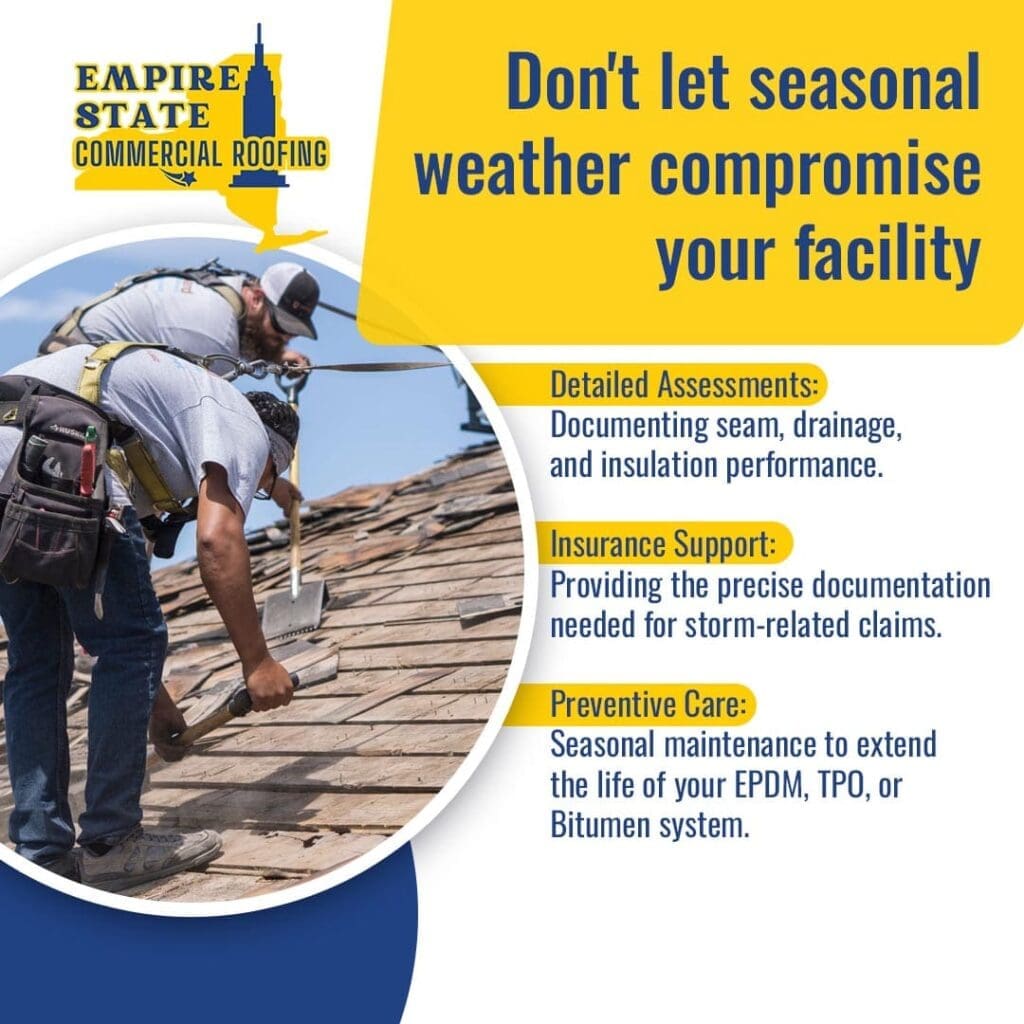
Each flat roofing material responds differently to storm exposure. Knowing how your specific roof type sustains damage is the first step toward an accurate post-storm assessment. A qualified roof repair contractor will identify damage patterns specific to your system and recommend the right repair approach.
EPDM Roofing
EPDM (ethylene propylene diene monomer) is a synthetic rubber membrane and the most widely installed flat roofing material on commercial buildings across Rochester and central New York. Its flexibility in cold temperatures makes it well-suited to the region’s winters, but it carries specific storm damage vulnerabilities.
- Wind uplift is a primary concern. Strong gusts create pressure differentials at the roof perimeter edges and corners that pull the membrane away from the substrate. Once the membrane separates at the edge, each subsequent wind event expands the affected zone further inward. This progression creates a large open area where water can enter freely.
- Hail impact on EPDM is often invisible at the surface. Hailstones that strike the membrane with sufficient force compress the insulation board beneath it, reducing the insulation’s R-value (its resistance to heat flow) and creating a moisture pathway even when the membrane surface appears undamaged. This is why a visual walk of the roof after a hailstorm is not a complete damage assessment. Infrared thermography or core sampling by a qualified storm damage roofing company near you is required to detect subsurface insulation compression.
- Seam fatigue also accelerates after storm events. Prolonged snow load and standing water following a storm wear down membrane seams, which are the most common water entry points on EPDM systems.
TPO Roofing
TPO (thermoplastic polyolefin) is a single-ply membrane with a white reflective surface that reduces solar heat absorption during warmer months. It is widely installed on commercial buildings across Rochester and is commonly found on warehouses, retail centers, and office buildings throughout the region.
TPO membranes are heat-welded at seams during installation. When those welds are executed correctly, they create a strong bond. Under the thermal cycling that Rochester’s climate produces across seasons, however, improperly welded seams can fail and become active leak points after storm events.
Wind-driven rain presents a specific risk for TPO installations. Water moving horizontally at high speed during a storm can penetrate any gap at the roof edge, flashing termination, or seam, particularly if the membrane has experienced prior storm exposure and the surface layer has begun to fatigue. Contacting a storm damage contractor near you promptly after a wind or rain event limits how far that damage progresses.
Modified Bitumen Roofing
Modified bitumen is an asphalt-based roofing material reinforced with polyester or fiberglass and modified with rubber or plastic compounds for added flexibility and durability. It is commonly found on older commercial buildings across Rochester and central New York and is still actively installed on low-slope roofs throughout the region.
Storm damage on modified bitumen roofs most often appears as blistering, cracking, or surface erosion after repeated hail and freeze-thaw exposure. Seams and laps are also common failure points after wind events. Because the material relies on multiple bonded layers, water that infiltrates one layer can travel beneath others before it becomes visible inside the building. An experienced roof repair contractor will use moisture detection tools to locate the true source of the intrusion, not just the point where it surfaces.
Spray Polyurethane Foam Roofing
SPF (spray polyurethane foam) roofing is applied as a liquid that expands and hardens into a seamless, monolithic layer with built-in insulation and waterproofing. Because it has no seams or laps, it removes the most common structural weak points where membrane-based systems sustain storm damage.
Closed-cell foam also stops lateral water migration. If a puncture or crack forms at one location, moisture remains localized at that point rather than traveling through the roof assembly. This containment property limits the scope of repairs when the system is properly maintained.
The primary storm vulnerability in an SPF system is the protective elastomeric coating applied over the foam. If that coating is breached by hail impact or UV wear, exposed foam can absorb moisture. Periodic recoating restores full waterproofing performance and extends the system’s service life.
Empire State Commercial Roofing installs and restores spray foam roofing systems on commercial and industrial buildings across central New York.
Identifying Storm Damage on a Commercial Flat Roof
Many commercial flat roof failures after storms are not immediately visible from the ground or from a standard roof walk. The most consequential damage requires professional assessment to detect. Building owners who conduct informal post-storm checks may miss subsurface failures entirely. The following breaks down damage indicators by storm type.
Wind Event Indicators
Windstorm damage on flat roofs begins at the perimeter edges and corners. Signs to look for after a high-wind event include:
- Lifted or separated membrane edges along the roof perimeter
- Loosened or missing flashings around HVAC units, skylights, and vents
- Displaced rooftop equipment or debris
- Drafts or unexpected temperature changes inside the building near the roofline
Any of these signs warrants a call to a storm damage repair contractor for a professional assessment before conditions worsen.
Hail Event Indicators
Visible dents on metal flashings, HVAC equipment, or rooftop fixtures confirm that hail struck the building. However, the absence of visible membrane damage does not confirm that no damage occurred. Subsurface insulation compression can be present under a visually intact membrane surface. Any confirmed hail event should be followed by a professional inspection that includes moisture detection, not just a visual surface check.
Snow Load and Ice Damage Indicators
Ice dams form when heat escaping through the roof melts accumulated snow at the surface, and that meltwater refreezes at the cooler roof edge. Water forced beneath membrane edges and flashings by ice dams often shows up as interior ceiling stains days or weeks after the weather event itself.
Standing water that remains on the roof for more than 48 hours after any storm accelerates membrane wear and increases the risk of structural stress at the contact point. Monitoring drainage performance after major snow or rain events is a practical step for any facility manager overseeing a flat-roof building.
Storm Damage Repair Process for Commercial Flat Roofs
Storm damage roof repair on a commercial flat roof follows a structured process. Understanding each stage helps building owners set accurate expectations for timeline, documentation, and outcomes.
Professional Inspection and Damage Assessment
The process begins with a detailed inspection by an experienced roof repair contractor. A thorough post-storm assessment goes beyond a visual surface check. It includes examination of seams, flashings, perimeter edges, drainage outlets, and rooftop penetrations. For hail events, infrared thermography or core sampling may be used to detect insulation compression beneath an intact membrane surface.
The inspection produces a written report with photographs, moisture readings where applicable, and a repair scope tied specifically to storm-related damage rather than general wear. That documentation is also the foundation for an insurance claim.
Targeted Repairs Versus Full Restoration
Not every storm-damaged flat roof requires full replacement. Targeted storm damage roof repair addresses isolated failures, including punctures, separated seams, lifted membrane edges, and damaged flashings, when the roof deck and insulation remain structurally sound.
Full restoration becomes the appropriate path when:
- Storm damage covers more than 25% of the total roof surface.
- Insulation saturation is widespread rather than isolated.
- The roof deck shows structural deterioration.
- The system has experienced repeated storm repairs without lasting resolution.
When it comes to deciding between restoration and replacement, working with a qualified storm damage contractor near you makes all the difference. A documented inspection with moisture data, photographs, and a written repair recommendation gives you a clear picture of your roof’s condition rather than a general estimate.
Repair Execution and Quality Verification
Repair work on commercial flat roofs is sequenced to address root causes, not just visible symptoms. Surface preparation and cleaning precede any sealant or coating application. Flashings are resealed or replaced around all penetrations. Membrane separations are re-adhered or patched with compatible materials. Drainage outlets are cleared and tested.
After repairs are complete, a final inspection verifies that all work meets specifications and that water drains correctly from the repaired areas.
Insurance Documentation for Storm Damage Claims
Commercial property insurance typically covers storm-related damage from hail, high winds, and ice. Damage attributed to deferred maintenance or gradual wear is generally excluded. Accurate documentation is what separates a supported claim from a disputed one. Steps to take immediately after a storm:
- Photograph all affected areas with timestamped images, including roof surfaces, flashings, and interior ceiling stains or displaced equipment.
- Record the storm date and attach supporting weather data from the National Weather Service or NOAA.
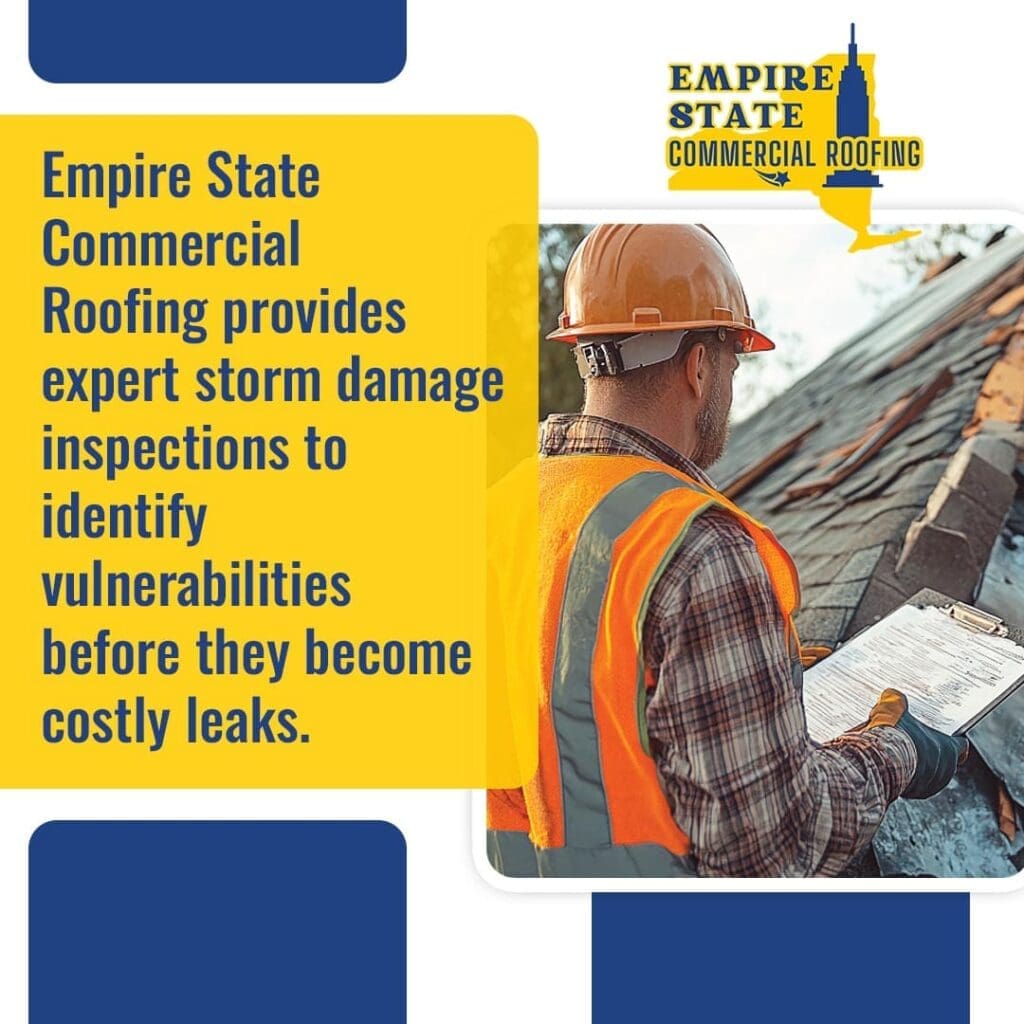
- Obtain a written inspection report from a licensed storm damage repair contractor that includes moisture readings and a repair scope tied to the storm event.
- Document any temporary protective measures taken and retain associated receipts.
- Contact your insurer promptly and request their documentation requirements in writing.
At Empire State Commercial Roofing, we provide full documentation support for commercial property owners across Rochester and the surrounding communities, from initial inspection through claim submission.
Reducing Storm Damage Through Preventive Maintenance
A structured maintenance plan is the most practical way to reduce storm damage frequency and limit the scope of repairs when a weather event does occur. For commercial flat roofs in central New York, a maintenance program should include:
- Spring inspection: Check for damage from the previous winter’s freeze-thaw cycles and ice dams. Clear all drainage outlets after winter debris accumulation.
- Fall inspection: Identify seam fatigue and coating deterioration before winter begins. Reseal flashings around HVAC units, vents, and skylights.
- Post-storm inspection: Following any significant hail, wind, or ice event, schedule a professional roof assessment. A facility staff walkthrough is not a substitute.
- Coating and seam maintenance: Address seam separations and reapply protective coatings on schedule before minor wear develops into active leak points.
Annual maintenance plans from a trusted storm damage roofing company near you reduce emergency repair frequency, extend roof service life, and maintain the documentation record that supports insurance claims over time.
Empire State Commercial Roofing: Storm Damage Roof Repair Services in Rochester, NY
At Empire State Commercial Roofing, we have been serving commercial building owners, facility supervisors, and maintenance managers across Rochester, NY, and nearby areas since 2012. As a trusted storm damage roofing company near you, we bring hands-on experience across all major flat roofing systems, including EPDM, TPO, modified bitumen, and spray foam roofing. We handle everything from post-storm inspections and targeted repairs to full roof restoration, all without requiring a tear-off in most cases.
Every project we take on is backed by a leak-free warranty and the option for an annual maintenance plan that keeps your roof in documented, inspectable condition year after year. We work with building owners through the full storm damage roof repair process, from the initial inspection and written assessment through repair completion and insurance claim documentation
If your commercial property has experienced storm damage or you want to get ahead of the next weather event, we are ready to help. Call Empire State Commercial Roofing at (315) 857-6988 to schedule a commercial roof inspection and discuss your repair options.