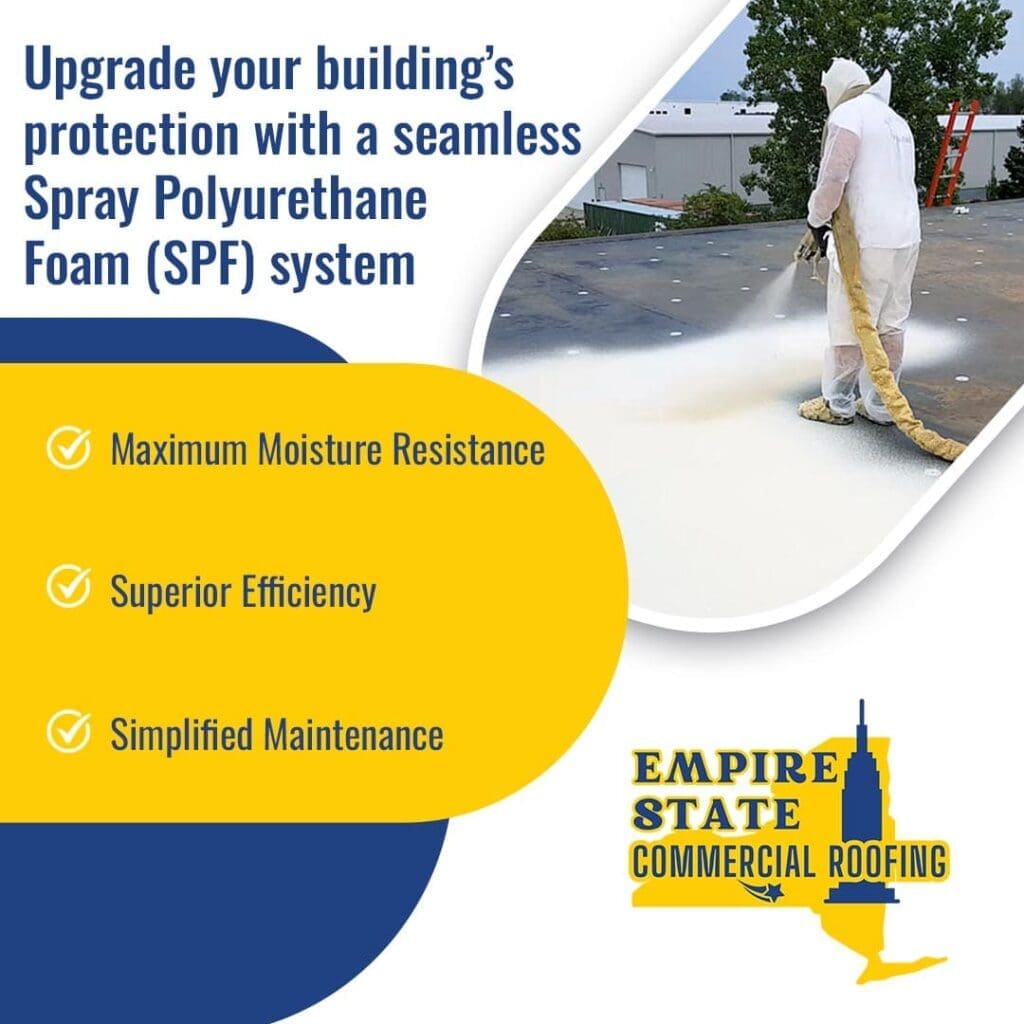
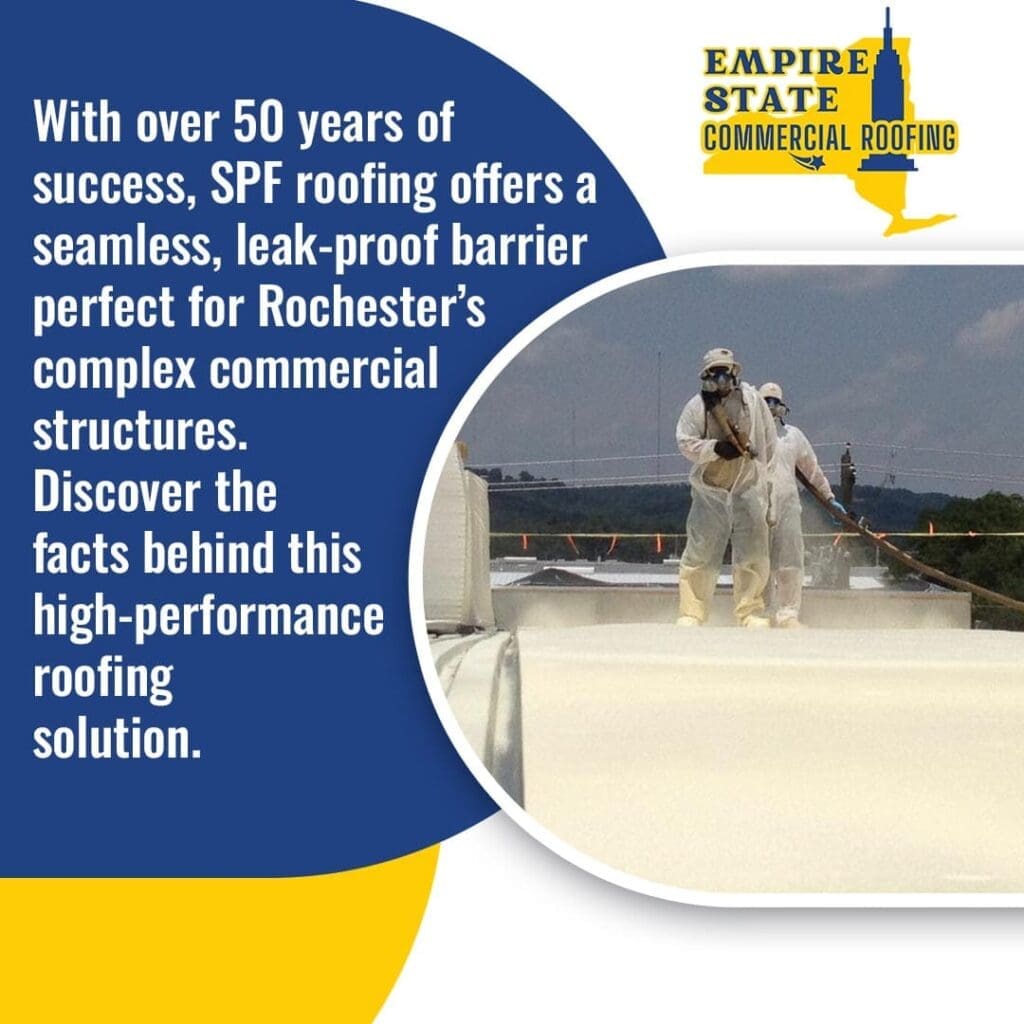
Spray polyurethane foam (SPF) roofing is a liquid-applied system that expands on contact into a seamless, insulated barrier. For commercial buildings across Rochester, NY, including warehouses, office facilities, and industrial properties, spray foam roofing has delivered reliable performance for over five decades, with roots in commercial applications dating back to the early 1970s. Yet a number of persistent myths continue to steer building owners away from a system that has a well-documented track record in commercial and industrial applications.
Empire State Commercial Roofing has worked with facility managers and building owners across Central New York since 2012, providing commercial spray foam roofing service alongside metal roof restoration, roof coatings, and full-service commercial roofing solutions. Our team regularly encounters the same misconceptions about spray foam roofing, and those misunderstandings often lead to decisions that cost more time and money than necessary. This article addresses those myths directly, using verified data and industry standards, so property owners in Rochester, NY, can make informed decisions based on facts.
Common Myths About Commercial Spray Foam Roofing
Myth 1: Spray Foam Roofing Is New and Untested
SPF roofing has been in active commercial use since the early 1970s, making it approximately 50 years old as a roofing technology.
The foundational research on polyurethane foam was conducted in 1937 by Dr. Otto Bayer and his team. Commercial production began in the 1950s, and by the early 1970s, contractors were applying it to large-scale roofing projects across the country.
The National Roofing Contractors Association (NRCA) and the Spray Polyurethane Foam Alliance (SPFA) both recognize SPF as a proven roofing technology. The material is also acknowledged by the National Building Code for its performance in reducing penetrations to the building envelope.
For Rochester-area building owners weighing their options, the age and breadth of SPF’s track record place it firmly in the category of established, time-tested roofing systems.
Myth 2: Spray Foam Absorbs Water and Causes Leaks
Properly installed closed-cell SPF does not absorb water. Its cellular structure makes it physically impenetrable to moisture.
The SPF used in commercial spray foam roofing is closed-cell foam, a dense material made up of millions of sealed cells that water cannot enter. This is distinct from open-cell foam, which is softer and used for interior insulation purposes only. A block of closed-cell SPF submerged in water remains dry and buoyant. The same material is used in flotation docks and marine vessel hulls for this exact property.
Because SPF is sprayed on as a continuous liquid that hardens in place, it forms a seamless, monolithic layer with no joints or seams. Traditional roofing systems, including single-ply membranes and built-up roofing, rely on overlapping layers and seams that are common failure points over time.
How This Applies to Flat Commercial Roofs
A flat warehouse roof with poor drainage is highly vulnerable to ponding water. SPF can be applied to fill low areas and create a positive slope, while the closed-cell structure prevents moisture from working through the surface.
A factory building with multiple HVAC penetrations and curbs creates numerous opportunities for water intrusion. Sprayed foam conforms tightly around each penetration, eliminating the gap that would exist with cut-and-fit membrane systems.
If water absorption does occur in an SPF roof, it results from improper installation or the use of incorrect foam type, not from the material itself. This is why contractor selection is a primary factor in long-term roof performance.
Myth 3: You Cannot Walk on a Spray Foam Roof
SPF roofing can support the weight of a person. Both the SPFA and NRCA establish a minimum compressive strength of 40 PSI for roofing-grade foam, with most commercial systems achieving 40 to 70 PSI.
Maintenance technicians, HVAC crews, and roofing inspectors access SPF roofs routinely without issue. Soft-soled footwear is recommended, and sharp objects should be avoided. These are the same standard precautions that apply to most low-slope roofing systems.
Protective coatings applied over the foam layer add further surface durability. Some coating systems include embedded granules that improve traction and reduce surface wear from regular foot traffic.
Myth 4: Spray Foam Roofing Is Only Suitable for Warm Climates
SPF roofing is installed and performs well across all U.S. climate regions, including those with cold winters, heavy snowfall, and significant temperature swings.
Rochester, NY, experiences some of the most demanding seasonal weather in the northeastern United States. Freeze-thaw cycles, heavy snow loads, and humidity fluctuations place real stress on commercial roofing systems.
SPF roofing addresses these conditions directly. Its seamless application eliminates joint failures that freeze-thaw cycles accelerate in seamed systems. Its high R-value (thermal resistance) reduces heat loss through the roof in cold months, lowering the building’s heating load. Reflective protective topcoats reduce solar heat gain in summer, which helps manage cooling demands.
Spray Foam Roofing and Rochester’s Winter Conditions
Traditional roofing systems with seams and fasteners are vulnerable to the expansion and contraction that comes with Rochester’s temperature extremes. Because SPF is a monolithic layer applied directly to the substrate, it moves with the building rather than pulling apart at joints.
Commercial spray foam roofing contractors familiar with Central New York weather will also account for dew point and humidity conditions during installation, following SPFA guidelines that specify foam should not be applied when the surface temperature is within five degrees of the current dew point.
Myth 5: Spray Foam Roofing Can Only Be Installed in Perfect Weather
SPF roofing is successfully installed across all U.S. geographic regions. The general application window is 45°F to 120°F, covering a wide range of working conditions.
The key variable is substrate moisture. The roof surface must be dry at the time of application. Experienced spray foam roofing contractors monitor dew point, humidity, temperature, and wind conditions before and during every project.
For Rochester, NY building owners, this means scheduling and pre-installation preparation are important parts of the process. Working with spray foam roofing contractors near you who have regional experience makes a practical difference. They understand local seasonal patterns and plan accordingly. The application is not limited to the summer months. Many projects are completed successfully in spring and fall with proper preparation and monitoring.
Myth 6: Spray Foam Roofing Is Difficult to Repair
SPF is one of the more straightforward commercial roofing systems to repair. Spot repairs can be completed with compatible foam, caulking, and a fresh protective coating application.
Unlike systems that require cutting out and replacing entire membrane sections, damaged areas in an SPF roof can be addressed locally. A small puncture or surface crack typically requires cleaning the area, applying sealant or caulking, and recoating. There is no need to disturb the surrounding material.
Suppose a maintenance technician accidentally punctures the roof surface while servicing rooftop equipment. The repair involves cleaning the affected area and applying foam caulking topped with a matching elastomeric coating. The weathertight barrier is restored without a full section replacement.
Annual inspections help identify small issues before they require more involved work. Empire State Commercial Roofing offers annual maintenance plans designed to keep SPF roofs performing at capacity with minimal disruption to building operations.
Myth 7: Spray Foam Is Toxic or Harmful to Building Occupants
Once fully cured, typically within 24 hours of application, polyurethane foam is chemically inert. It is not expected to pose an ongoing health risk when fully cured and properly installed.
The cured material is the same class of polyurethane found in everyday products: mattresses, furniture cushions, refrigerator insulation, and car seat padding. It does not off-gas after curing and is resistant to mold or mildew growth.
Newer polyurethane foam formulations increasingly use renewable raw materials such as soy and castor oil, and many SPF products are promoted as green-building compatible when they are properly installed and maintained.
During the application process, building occupants and non-essential personnel should remain clear of the work area until curing is complete. Your contractor should provide clear guidance on re-entry timelines before work begins.
Myth 8: Spray Foam Roofing Performance Depends on the Foam, Not the Contractor
Contractor skill and certification are the primary factors in whether an SPF roof performs as expected. The material alone does not guarantee results.
SPF application requires specialized equipment, precise chemical ratios, and trained technique. If spray pressure, substrate preparation, or coating application is done incorrectly, it can cause adhesion problems, surface defects, or moisture issues. These problems come from poor installation, not from the foam itself when it is properly applied. That is why SPFA maintains contractor certification standards for spray foam roofing contractors.
When evaluating spray foam roofing contractors near you, these questions are worth asking directly:
- Are your installers SPFA-certified or trained through an equivalent body?
- How many commercial SPF roofing projects have you completed in Central New York?
- What protective coating systems do you pair with SPF installation, and why?
- What warranty do you provide on both materials and labor?
- Do you offer ongoing maintenance or inspection programs after installation?
Reputable contractors will answer each question directly and can provide references from comparable commercial projects in the region.
Role of Protective Coatings in SPF Roofing
SPF roofing is always paired with a protective topcoat, typically silicone, acrylic, or polyurethane-based. This coating layer protects the foam from UV degradation, which would otherwise cause surface erosion over time, and adds a secondary waterproofing layer.
The coating is what gets periodically renewed over the life of the roof, not the foam layer itself. When recoating is done on schedule, the underlying SPF continues to perform without full replacement. This makes SPF roofing a renewable system rather than a disposable one.
Why Rochester Building Owners Work With Empire State Commercial Roofing
Empire State Commercial Roofing has delivered commercial spray foam roofing service across Central New York since 2012. Building owners, facility supervisors, and maintenance managers across Rochester, Syracuse, Canandaigua, Geneva, Henrietta, and Painted Post, NY, work with our team because our spray foam installations are built to perform through Central New York’s harshest seasons, backed by a leak-free warranty and structured maintenance support.
Roof Restoration Without Tear-Off
Our spray foam commercial roofing process restores existing roofs to working condition without the disruption and expense of a full tear-off. This approach works well for warehouses, factory buildings, office facilities, and shopping centers where operational continuity matters.
Leak-Free Warranty and Annual Maintenance Plans
Every project we complete is backed by a leak-free warranty. We also offer annual maintenance plans that include scheduled inspections and minor repairs, keeping your roof performing without the need for reactive emergency calls.
A Simple, Transparent Process
From the initial roof inspection through estimating and project completion, our process is straightforward. Building owners know what to expect at each stage, and our team stays accessible from start to finish.
Schedule a Commercial Roof Inspection in Rochester, NY
The myths covered in this article share a common thread. They are best resolved by working with experienced spray foam roofing contractors near you who can assess your specific building, answer your questions directly, and back their work with a warranty.
If your commercial property in Rochester, NY needs a roof inspection or you want to learn whether spray foam is the right fit for your building, call Empire State Commercial Roofing at (315) 857-6988 or visit our contact page to submit a request.